TLDR
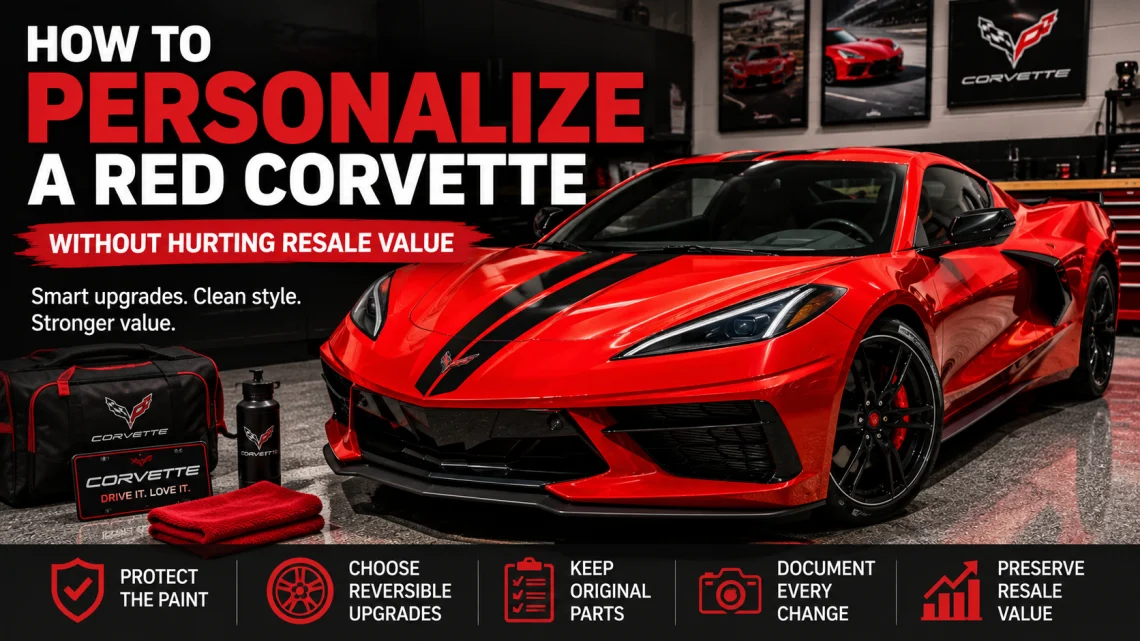
- The safest Corvette modifications are reversible, professionally installed, and completed without cutting factory parts.
- Keep every original component, including wheels, exhaust parts, trim, badges, and interior pieces.
- Rare, highly original, and low-mileage Corvettes usually deserve a more conservative approach than common driver-quality cars.
- Factory accessories, paint protection film, fitted floor mats, reversible wheel changes, and display graphics offer personalization with relatively low risk.
- Permanent paint changes, aggressive tuning, hacked wiring, extreme suspension work, and irreversible body modifications can reduce the number of interested buyers.
- Document every change so a future buyer can understand exactly what was done.
A red Corvette does not need much help getting noticed. That is exactly why personalization can go wrong so quickly. A few carefully chosen details can make the car feel like yours. Too many competing changes can make it look unfinished and may narrow the market when it is time to sell.
The safest way to personalize a red Corvette is to treat every modification as a decision about both enjoyment and reversibility. You do not have to keep the car completely stock. But it helps to know which changes can be undone cleanly, which ones alter the car permanently, and which ones make sense for your specific Corvette.
A driver-quality C5 is not the same financial decision as a documented C2, a low-mileage C7 ZR1, or a new C8 still under warranty. Start with the car you actually own, not the build you saw on social media.
Decide What Kind of Corvette You Are Modifying
Before ordering parts, place your Corvette into one of three broad categories.
A Collectible or Highly Original Corvette
This includes rare configurations, historically significant cars, documented survivors, high-quality restorations, and unusually low-mileage examples.
Originality can play a major role in the appeal of these Corvettes. The National Corvette Restorers Society uses originality as a central part of its traditional judging system, although modified Corvettes can also qualify for separate forms of judging.
On a collectible car, even a well-executed modification can remove something a future buyer values. Drilled holes, replaced trim, nonfactory paint, modernized wiring, or missing original parts may matter more than the improvement itself.
The safest approach is preservation. Use accessories that can be removed without leaving evidence.
A Modern Low-Mileage Corvette
A newer Stingray, Grand Sport, Z06, ZR1, or E-Ray may not yet be considered a traditional collectible, but condition and factory configuration can still affect resale value.
Many buyers shopping for a late-model performance car prefer one that appears unmodified. Aggressive engine tuning, suspension changes, loud exhaust work, or nonfactory wiring can make them wonder how the car was driven.
Tasteful, reversible upgrades are usually the best middle ground.
A Driver-Quality Corvette
A regularly driven Corvette with average mileage, existing cosmetic wear, or prior modifications gives the owner more flexibility.
That does not mean every modification adds value. Most aftermarket parts do not return their full cost when the car is sold. But the owner may reasonably place more weight on daily enjoyment than strict originality.
The important part is making changes well. A clean, documented modification can attract the right buyer. A rushed installation usually creates questions.
Use the Five-Question Reversibility Test
Before modifying a Corvette, ask five questions.
- Does the upgrade use existing mounting points?
A bolt-on part is generally easier to reverse than one requiring drilled holes, cut fiberglass, welded brackets, or modified factory panels. - Will factory wiring remain intact?
Plug-and-play electrical accessories are safer than installations involving cut wires, improvised connectors, or permanent changes to the harness. - Can the original parts be stored?
Wheels, exhaust components, badges, trim, steering wheels, radios, and air-intake parts should be kept whenever practical. - Can the car be returned to stock without visible evidence?
Removing an accessory is not enough if it leaves holes, adhesive damage, mismatched paint, or a cut panel behind. - Could the change affect the warranty, insurance, emissions compliance, or inspection?
Rules vary by modification and location. Check before changing engine software, emissions components, exterior lighting, window tint, or safety systems.
A modification does not need to pass all five questions to be worthwhile. But each “no” raises the long-term risk.
Low-Risk Ways to Personalize a Red Corvette
The best low-risk changes add character without taking over the car.
Fitted Floor and Cargo Mats
Floor mats are one of the easiest places to add color, logos, stitching, or model-specific branding.
They can also protect the original carpet. That matters on light interiors, older cars, and Corvettes that see regular use.
Choose mats that fit correctly and work with the factory retention system. A loose mat near the pedals is not a harmless cosmetic issue.
Keep the original mats clean and stored flat.
License Plate Frames
A Corvette-branded or color-matched license plate frame adds a small amount of detail without changing the car itself.
Chevrolet sells licensed Corvette frames through its official accessory catalog. Availability and fitment vary, so confirm the part against the model year or VIN.
This is a modest upgrade, which is part of its appeal. Red paint already carries a lot of visual weight.
Interior Storage and Protective Accessories
Console organizers, cargo liners, seat protectors, sunshades, and fitted covers can make the car easier to use while protecting the factory surfaces.
Choose accessories that sit securely and do not use adhesives on leather, soft-touch trim, or delicate vintage materials.
Display Materials
Personalization does not have to go directly on the car.
A display board, garage sign, detailing case, document binder, cooler, tool chest, or trailer can carry your club logo, Corvette nickname, race number, or custom artwork.
This is especially useful for owners who attend shows but do not want to alter original paint or glass.
Comparing Common Corvette Modifications
| Modification | Reversibility | Typical Resale Risk | Best Practice |
|---|---|---|---|
| Fitted mats and cargo liners | High | Low | Keep the factory pieces |
| License plate frame | High | Low | Use correct hardware and avoid scratching paint |
| Window or display decals | High when properly selected | Low | Use them on sound glass or separate display items |
| Paint protection film | Moderate to high | Low when professionally installed | Inspect paint first and save installer records |
| Aftermarket wheels | High | Low to moderate | Keep the original wheels, sensors, and hardware |
| Bolt-on cat-back exhaust | Moderate to high | Moderate | Keep the factory exhaust and avoid emissions changes |
| Removable vinyl accents | Moderate | Low to moderate | Use a qualified installer and inspect prior paintwork |
| Lowering springs or coilovers | Moderate | Moderate | Avoid extreme ride heights and preserve factory parts |
| Engine tune | Variable | Moderate to high | Understand warranty, emissions, and service implications |
| Custom paint or permanent bodywork | Low | High | Reserve for a committed custom build |
These are general risk levels, not guarantees. A rare wheel package may be treated differently from an inexpensive factory wheel. And a professionally built restomod may attract more money than an unfinished stock car. The audience simply becomes more specialized.
Personalize a Red Corvette With a Simple Color Plan
Red works well with black, silver, gray, white, carbon-fiber finishes, and restrained body-color details.
The problem is not finding a color that works. The problem is knowing when to stop.
A useful approach is to select one supporting finish and repeat it in a few places. For example:
- Red body with black wheels, black badges, and a black license plate frame
- Red body with silver wheels and brushed-metal interior details
- Red body with carbon-fiber aero and minimal additional graphics
- Red body with white racing accents used only on removable materials
Try to avoid stacking every available option onto the same car. Black wheels, yellow brake calipers, carbon side skirts, chrome badges, blue interior trim, white stripes, and several different decal styles may each look good separately. Together, they can compete for attention.
Use a photograph of the car to mock up changes before buying anything. Even a basic digital preview can reveal that an idea is too large, too bright, or unnecessary.
Use Paint Protection Film as Protection, Not Decoration
Paint protection film, commonly called PPF or clear bra, is a transparent urethane film placed over painted surfaces.
It is commonly used on high-impact areas such as:
- Front bumpers
- Hood leading edges
- Full hoods
- Front fenders
- Mirror caps
- Rocker panels
- Door edges
- Areas behind the rear wheels
For a low Corvette, these surfaces are exposed to rocks, insects, sand, and road debris. Modern PPF products are designed to protect against chips, light scratches, stains, and environmental exposure.
PPF can be a reasonable resale-friendly investment when the factory paint is in good condition and the installation is done properly. It changes the protective layer rather than the underlying color.
But film is not risk-free. Paint condition matters. Poorly cured resprays, failing clearcoat, touch-up work, and older repainted panels may be more vulnerable during installation or removal.
Ask the installer to inspect the car first. Also ask about edge placement, visible seams, warranty coverage, removal, and care instructions.
Consider Removable Vinyl Accents Carefully
A roof panel, stripe, mirror cap, or selected trim piece can sometimes be wrapped without repainting the car.
This gives the owner a chance to change the appearance while preserving the factory color underneath. Reputable automotive film manufacturers generally recommend professional installation and removal, especially on cars with previous bodywork.
Vinyl accents work best when they follow the car’s existing lines. A narrow stripe or wrapped roof panel usually feels more deliberate than several unrelated graphics placed across different surfaces.
Do not assume that every vinyl product is safe for every Corvette. Automotive wrap film, paint protection film, and printed stickers are different products with different adhesives and installation requirements.
Avoid applying film over loose paint, damaged clearcoat, uncured repairs, or unknown older finishes.
Use Custom Stickers Without Risking Valuable Paint
Custom stickers can add personality, but placement matters.
For a Corvette where originality or paint condition is important, use stickers on items that can be replaced or cleaned easily. Good options include:
- A rear or side window, after checking visibility laws
- A removable display panel
- A detailing case
- A track-day storage bin
- A document binder
- A cooler or folding chair
- A trailer, cabinet, or garage toolbox
- A temporary event sign
CustomStickers.com produces custom vinyl stickers with a weatherproof, UV-resistant laminate. That makes them useful for Corvette club graphics, event handouts, garage displays, and outdoor accessories.
Before applying any sticker directly to a car, confirm that the adhesive and intended use are appropriate for the surface. Avoid aged paint, fresh paint, restored lacquer, failing clearcoat, delicate trim, and unknown repaints.
And do not assume a vinyl sticker and a professionally installed vehicle wrap will remove in the same way. They are separate products.
Wheels Can Change the Car Without Changing the Car
Wheels have a major effect on a red Corvette because they occupy so much visual space.
Black wheels can make the car look more modern and aggressive. Silver or machined wheels can emphasize the body lines and work well on earlier generations. Bronze and gold can work, but they create a stronger theme and may narrow buyer appeal.
A wheel change is usually reversible, provided the new setup has correct:
- Diameter and width
- Offset and backspacing
- Load rating
- Tire size
- Brake clearance
- Hub fitment
- Sensor compatibility
- Lug or stud requirements
Do not discard the factory wheels. Store them indoors, clean them first, and protect the faces from contact.
A future buyer may prefer the aftermarket wheels. But having the originals removes the need to guess.
Treat Exhaust Changes as a Medium-Risk Decision
A bolt-on exhaust can improve the sound of a Corvette without opening the engine or permanently changing the body.
But sound is subjective. The exhaust tone that makes one owner smile may give another buyer a headache on the highway.
Before ordering a system, listen for:
- Cold-start volume
- Highway drone
- Sound with the roof removed
- Sound inside the cabin
- Compatibility with factory exhaust modes
- Ground clearance
- Local noise requirements
Keep the original exhaust if storage allows. Also avoid cutting factory pieces when a bolt-on solution is available.
Do not remove catalytic converters or emissions equipment. Aside from legal concerns, those changes can make the car harder to sell, inspect, insure, or service.
Keep Every Original Part
The easiest way to lose flexibility is to sell the factory pieces after installing aftermarket parts.
Original Corvette parts can become difficult or expensive to replace. This is especially true for generation-specific trim, wheels, exhaust components, radios, air cleaners, intake parts, and dated restoration pieces.
Label stored parts with:
- Corvette year
- Vehicle identification number, when appropriate
- Date removed
- Mileage at removal
- Part number
- Left or right position
- Hardware included
Use sturdy boxes and keep small fasteners in labeled bags. Take photographs before and after installation.
Not the most exciting part of modifying a car, but it prevents a surprising amount of confusion later.
Document the Work
Good documentation gives a future buyer a reason to trust the modification.
Keep a file containing:
- Purchase receipts
- Part numbers
- Installation instructions
- Installer invoices
- Alignment sheets
- Tuning records
- Warranty information
- Before-and-after photographs
- Dates and mileage
- Factory parts inventory
Documentation does not guarantee that a modification will add value. It does show that the work was planned rather than improvised.
That distinction matters.
Modifications That Commonly Narrow the Buyer Pool
Some changes can be reversed only with significant cost and labor.
These include:
- Cutting or drilling original fiberglass
- Permanent wide-body conversions
- Nonfactory paint changes
- Aggressive engine tuning
- Emissions-system removal
- Extreme lowering
- Hacked or undocumented wiring
- Fixed racing seats that remove street comfort or safety features
- Poorly fitted aero parts
- Oversized wheels that create rubbing or ride problems
- Interior dye or paint applied over original materials
- Removing identifying tags, labels, or factory documentation
None of these choices automatically ruins a Corvette. A complete custom build may be exactly what the owner wants.
But the car should then be viewed as a custom vehicle. Its value will depend more heavily on build quality, taste, documentation, and finding the right buyer.
Match the Modification Plan to the Corvette Generation
A simple generation-based approach can help.
C1 and C2
Originality, documentation, correct components, and restoration quality can carry considerable weight. Use a conservative approach unless the car is already a committed restomod.
C3 and C4
The answer depends heavily on condition, rarity, factory equipment, and intended use. A common driver can support thoughtful mechanical improvements. A rare or unusually original car may deserve preservation.
C5 Through C7
These generations respond well to reversible wheels, exhaust systems, interior accessories, paint protection, and carefully selected appearance changes.
Highly desirable models, special editions, and low-mileage cars still call for caution.
C8
The C8 offers many personalization options, but it also relies heavily on integrated electronics, active systems, cooling, software, and model-specific components.
Confirm fitment carefully. Consider warranty and service implications before tuning or altering electrical systems.
A Three-Level Personalization Plan
A practical way to control the project is to choose a level before spending money.
Level One: Accessories Only
Choose fitted mats, a license plate frame, protective film, display items, storage accessories, and garage graphics.
This offers personalization with little effect on the factory car.
Level Two: Reversible Bolt-Ons
Add wheels, a bolt-on exhaust, removable exterior accents, or plug-and-play interior details.
Keep the original parts and document the installation.
Level Three: Permanent Custom Build
Change the paint, body, engine, drivetrain, suspension, or interior in a significant way.
At this level, build for your own goals. Do not assume the cost of the modifications will be recovered later.
There is nothing wrong with reaching Level Three. It just deserves an honest budget and a clear plan.
Final Thoughts
The goal is not to avoid modifying every Corvette. The goal is to understand what each change costs beyond the purchase price.
The safest way to personalize a red Corvette is to use reversible upgrades, preserve the factory parts, and document the work. Begin with accessories and protection. Then move into wheels, exhaust, or removable appearance changes only when they suit the car.
And before making a permanent modification, ask a simple question: Would I still choose this if it added no resale value at all?
If the answer is yes, you may have found the right modification. Just build it properly.