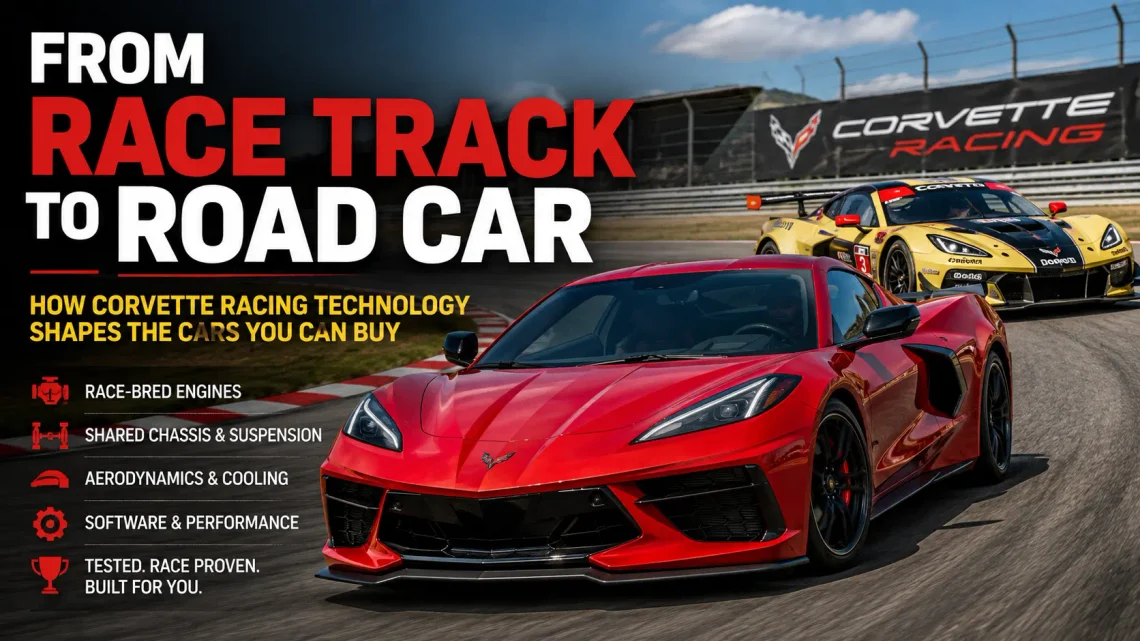
TLDR
- Corvette racing is not just a marketing exercise. Chevrolet uses motorsports to develop and refine production-car technology.
- The Corvette Z06 is one of the clearest examples of race-to-road engineering.
- The road-going Z06 and the Z06 GT3.R race car share important engine, chassis, suspension, and aerodynamic ideas.
- GM has stated that roughly 80% of the GT3.R engine is shared with the road-car engine.
- Lessons learned in endurance racing can improve performance, cooling, durability, software, and driver control systems.
If you have ever wondered whether Corvette racing success benefits the Corvette sitting in a driveway or garage, the answer is yes.
Automakers often talk about transferring technology from racing to road cars. But in Corvette’s case, the relationship is unusually direct. Chevrolet and GM describe the current generation of Corvette as the product of close cooperation between production engineers and motorsports teams, especially during development of the Z06 and Z06 GT3.R.
For Corvette owners, that matters. Part of the car’s identity is that it competes seriously, wins races, and brings some of those hard-earned lessons back to the production line.
Corvette Racing Is More Than a Heritage Story
Corvette has a long racing history, but the current motorsports program is not built around nostalgia alone.
The Corvette Z06 GT3.R was designed to compete in GT3 races and championships around the world. Unlike a one-off factory prototype, it is available to both professional and amateur customer teams.
Chevrolet describes the GT3.R as a street-inspired race car based on the Corvette Z06 and its 5.5-liter engine. The race car begins with a chassis produced at the Bowling Green Assembly plant before it is sent to Pratt Miller Engineering for its full competition conversion.
That gives the race car and road car a shared engineering foundation. Chevrolet is not creating a normal Corvette and then designing an unrelated race car that happens to look similar. The two programs are connected from the start.
The LT6 Engine Is the Clearest Race-to-Road Example
The 5.5-liter DOHC flat-plane crank V8 is probably the best example of Corvette’s current race-to-road philosophy.
The road-going Corvette Z06 uses the naturally aspirated LT6 engine. Its flat-plane crankshaft helps the engine rev higher and produce a sharper, more urgent character than the traditional cross-plane V8s found in most earlier Corvettes.
The Z06 GT3.R also uses a 5.5-liter DOHC flat-plane crank V8 derived from the road-going Z06. GM has said that roughly 80% of the race-car engine is shared with the road-car version.
That is a meaningful connection. Many performance cars borrow wings, vents, colors, and trim ideas from racing. Far fewer share such a large portion of their engine architecture with a current competition car.
The engine used in the race car is still adapted for racing rules, durability requirements, power limits, cooling demands, and serviceability. It is not identical to the production engine. But the underlying relationship is real.
And the development process works in both directions. Knowledge gained through Corvette racing helped shape the Z06 platform and LT6 engine, while the production car provided a strong starting point for the GT3.R.
The Chassis Starts in the Same Place
The connection between the Corvette Z06 and GT3.R goes deeper than the engine.
The GT3.R starts with the same basic aluminum chassis frame used for the production Z06. That frame comes from the Corvette assembly plant in Bowling Green, Kentucky.
Once the chassis reaches Pratt Miller Engineering, it receives the equipment needed for international GT3 racing. That includes a steel roll cage, competition suspension components, racing brakes, aerodynamic bodywork, safety equipment, and a sequential transmission.
The finished race car is obviously much more specialized than the road car. But using the production chassis as its foundation shows how capable the basic C8 structure is.
The Corvette was not designed as a soft grand tourer that engineers later tried to turn into a race car. The architecture was developed from the beginning with high-performance use in mind.
Why the Mid-Engine Layout Matters
The move to a mid-engine layout was one of the biggest changes in Corvette history.
Earlier Corvettes used a front-engine layout. That formula produced many excellent road and race cars, but it also created packaging and weight-distribution limits as Chevrolet continued pushing performance higher.
Moving the engine behind the passenger compartment changed what the Corvette engineering team could do.
A mid-engine layout places more of the vehicle’s mass near the center of the car. In practical terms, that can improve balance, traction, direction changes, and the ability to put power down when exiting a corner.
It also creates new options for aerodynamics and cooling. Air can be directed through side intakes, underbody channels, radiators, brake ducts, and rear openings in ways that would be difficult with a traditional front-engine layout.
This architecture is valuable on the road, but its advantages become even clearer in racing. A GT car must remain predictable while braking from high speed, turning through fast corners, riding curbs, and accelerating on worn tires. The C8 platform gives engineers a better foundation for managing those demands.
Suspension Development Connects the Two Cars
The Corvette Z06 and Z06 GT3.R both use double-wishbone suspension at the front and rear.
That does not mean the road and race cars have the same suspension setup. The GT3.R uses competition-specific springs, dampers, brakes, ride heights, wheels, tires, and alignment settings. Racing rules and track conditions also affect how the car is configured.
But sharing the same general suspension architecture is still important.
Double-wishbone suspension gives engineers detailed control over wheel movement and alignment behavior. It can help maintain tire contact as the car corners, brakes, and moves through changes in elevation.
The production Z06 has to balance track capability with road comfort, noise, tire life, and everyday usability. The GT3.R can make fewer compromises because it is built only for racing.
Even so, the shared layout means Chevrolet did not have to replace the basic road-car suspension concept to create a serious GT3 competitor. The foundation was already there.
Aerodynamics Do More Than Add Visual Drama
Modern Corvette aerodynamics are not only about making the car look aggressive.
Splitters, wings, diffusers, vents, underbody panels, and cooling openings all have specific jobs. They help control airflow around the car, reduce lift, create downforce, direct heat away from components, and maintain stability at speed.
The Z06 and GT3.R use related aerodynamic ideas, including similar approaches to front splitters. The race car then takes those concepts further with competition-specific carbon-fiber bodywork, a large rear wing, specialized underbody devices, and additional cooling ducts.
The GT3.R must also operate under balance-of-performance rules. Those rules are designed to keep different makes and models competitive with one another. As a result, the race car cannot simply use unlimited horsepower or downforce. Engineers need to make the entire package efficient and adaptable.
That challenge encourages better airflow management rather than relying only on brute force.
The same engineering culture can be seen in road cars such as the Corvette ZR1. High-speed stability, cooling, underbody airflow, and aero balance become critical when a production car is capable of speeds that were once limited to dedicated racing machines.
Racing Improves Cooling and Heat Management
Heat is one of the biggest enemies of performance.
A sports car may produce impressive numbers during a single acceleration run but struggle after several hard laps if its engine, transmission, brakes, tires, or electronics become too hot.
Endurance racing exposes these weaknesses quickly.
Events such as the Rolex 24 at Daytona, the 12 Hours of Sebring, and the 24 Hours of Le Mans require race cars to operate under stress for long periods. Cars must deal with changing temperatures, traffic, repeated braking, nighttime conditions, debris, and long stretches at high speed.
That environment gives engineers useful information about:
- Engine cooling
- Transmission temperatures
- Brake cooling
- Airflow through radiators
- Heat protection for electronics
- Tire temperature management
- Fluid durability
- Component wear
- Driver comfort
A road-going Corvette does not face the same conditions during normal use. But owners who attend track days, autocross events, or performance-driving schools still benefit from a car designed by engineers who understand sustained high-temperature operation.
Software Is Part of the Technology Transfer
Modern performance cars depend heavily on software.
The driver may feel the engine, steering, brakes, and tires, but software helps coordinate many of those systems. Traction control, stability control, launch control, electronic differentials, adaptive suspension, transmission programming, and drive modes all depend on careful calibration.
The GT3.R uses racing-specific systems, including adjustable traction control and anti-lock braking. Those controls must remain useful for different drivers, tracks, weather conditions, and tire situations.
The production Corvette has a different objective. Its software needs to support everyday driving while still allowing experienced drivers to explore the car’s capabilities in controlled settings.
Racing gives engineers another source of data. It helps them understand how drivers react to changing grip, how control systems should intervene, and how a vehicle behaves as tires and brakes begin to wear.
The road car does not simply receive race-car software. But the testing methods, data analysis, and control-system experience developed through racing can influence how production systems are built and calibrated.
Racing Also Tests Durability
Racing is often associated with speed, but endurance racing is just as concerned with survival.
A fast car that cannot finish is not useful. Teams need engines, gearboxes, suspension parts, cooling systems, electronics, and bodywork that can continue operating after hours of stress.
This makes the racetrack a valuable testing environment.
Production Corvette components are still developed under road-car standards, warranties, emissions requirements, and normal-use expectations. A race car follows a different maintenance schedule and receives regular inspection between sessions.
Even so, racing can reveal weaknesses that might be harder to reproduce during ordinary testing. It can help engineers understand vibration, temperature cycling, fluid behavior, material fatigue, and the effects of sustained loading.
That knowledge can influence future design choices, even when a specific race component never appears on a production Corvette.
The GT3.R Makes Corvette Racing More Accessible
The Z06 GT3.R also represents a change in how Corvette participates in global motorsports.
Earlier factory Corvette race cars were generally operated through a more centralized factory-backed program. The GT3.R was developed as a customer race car that could be purchased and operated by approved teams in multiple championships.
This matters because GT3 is one of the most widely used sports-car racing formats in the world. A GT3 Corvette can compete in different series while following a common technical framework.
Professional and amateur drivers can now race versions of the Corvette in more places. Customer teams also provide Chevrolet with information from a wider range of circuits, conditions, and operating styles.
That broader use can create more feedback for the program. It also puts the Corvette directly against race cars from manufacturers such as Porsche, Ferrari, BMW, Aston Martin, Lamborghini, Ford, and Mercedes-AMG.
What This Means for Corvette Owners
Most Corvette owners will never drive a GT3.R. And even a road-going Z06 remains very different from the full race car.
But the connection still matters.
The production Corvette benefits from a company culture in which performance is tested through real competition. Its engineers do not have to guess how a mid-engine chassis, high-revving V8, aerodynamic package, or cooling system behaves under stress. They can collect data from some of the most demanding tracks and races in the world.
That helps explain why the current Corvette feels so focused. The engine, chassis, cooling, airflow, and software were not selected only to create impressive specifications. They were developed within a program that expects the Corvette name to compete.
For enthusiasts, the racing connection is also part of Corvette ownership. Owners attend races, gather in Corvette corrals, join clubs, collect memorabilia, and build garages around the car’s history.
Custom club decals, garage graphics, event handouts, and race-inspired stickers can be ordered through CustomStickers.com. Using those graphics on display boards, storage cases, coolers, or garage cabinets is also a simple way to personalize the experience without changing the Corvette itself.
Race-Inspired Does Not Mean Race-Ready
It is important to keep the distinction between a track-capable road car and a dedicated race car clear.
A production Z06 is built to handle normal roads, stop-and-go traffic, weather changes, passenger comfort, emissions standards, and routine service. The GT3.R is built around competition regulations.
The race car includes specialized safety equipment and components that would be impractical on the street. It also operates with a race-team maintenance schedule.
Before taking a Corvette onto a racetrack, owners should still inspect the tires, brakes, fluids, alignment, and safety equipment. A car with strong racing DNA is not automatically prepared for unlimited track use without maintenance or preparation.
That is one of those details people sometimes overlook because the car feels so capable.
Frequently Asked Questions
Is the Corvette Z06 Actually Related to the GT3.R Race Car?
Yes. Chevrolet developed the road-going Z06 and Z06 GT3.R as closely connected programs. They share important engine technology, the same basic aluminum chassis frame, double-wishbone suspension architecture, and related aerodynamic thinking.
How Much of the GT3.R Engine Is Shared With the Road-Going Z06?
GM has stated that roughly 80% of the GT3.R engine is the same as the engine in the road-going Corvette Z06. The race version is still modified to meet competition rules and endurance-racing requirements.
Do the Z06 and GT3.R Use the Same Chassis?
The GT3.R begins with the same basic aluminum chassis frame used for the production Z06. Pratt Miller Engineering then adds a roll cage and the other structural, mechanical, aerodynamic, and safety equipment required for racing.
Is the GT3.R Street Legal?
No. The Corvette Z06 GT3.R is a track-only race car built to international GT3 regulations. It is not designed or certified for normal road use.
Does Corvette Racing Directly Improve Production Cars?
Not every race component appears in a production Corvette. However, racing helps Chevrolet test engine technology, cooling, aerodynamics, chassis behavior, software, reliability, and materials under demanding conditions. Those lessons can influence production-car development.
Can a Standard Corvette Be Used on a Racetrack?
Many Corvettes can be used during track days when properly prepared. The required preparation depends on the model, track, event rules, driver experience, and condition of the car. Tires, brakes, fluids, alignment, and safety equipment should be checked before driving on track.
Final Thoughts
Corvette has long promoted the idea that racing can improve the cars owners drive. In the current generation, Chevrolet has provided strong evidence that the connection is real.
The Corvette Z06 and Z06 GT3.R share meaningful engineering DNA. Their engines, chassis origins, suspension layouts, aerodynamic ideas, and development programs are closely related.
The road car is not simply decorated to resemble a race car. It comes from the same broader engineering program.
That is one reason the Corvette remains such an important American performance car. Its racing history is not sitting behind glass. Chevrolet is still adding to it, and current Corvette owners benefit from the work being done on the track.