TLDR
The best Corvette show documentation display has two parts: a clean public placard that can be understood in less than a minute, and a protected binder or folio containing the supporting records. Keep both beside the car rather than on its paint, glass, seats, or engine. Display copies instead of irreplaceable originals, redact private information, and label replicas or reproductions honestly. Most importantly, treat the placard as storytelling—not as proof that every claim about the Corvette has been formally verified.
A Corvette show documentation display should make the car easier to appreciate without becoming the main attraction. Spectators usually want the year, color, drivetrain, important options, and the short version of the car’s history. Judges and knowledgeable enthusiasts may want to examine factory records, restoration photographs, invoices, component details, and references. Trying to put all of that on one board creates clutter and often hides the Corvette you worked so hard to prepare.
Build Two Displays, Not One Giant Board
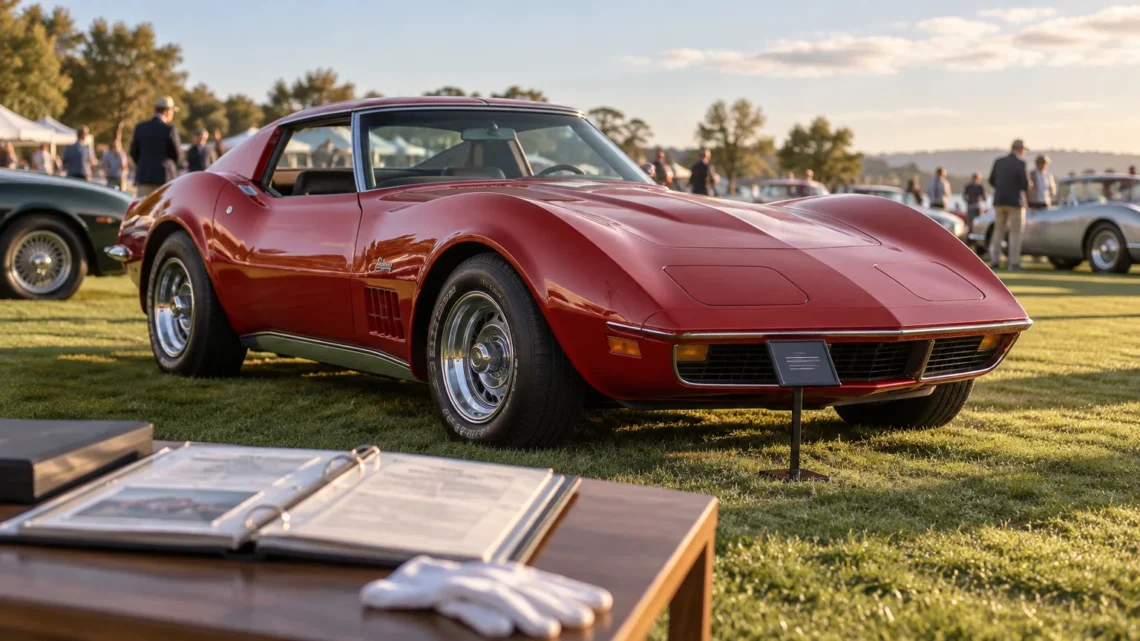
Think of the public placard as the car’s introduction. It should answer the obvious questions from several feet away and give an interested visitor a reason to look more closely. A separate folio is where you place the supporting material that takes time to examine.
This separation also keeps the presentation flexible. At a relaxed cruise-in, you may use only the placard. At a marque show, you can place the folio on a stand or keep it behind the car until somebody asks. In a formal judging environment, you can present relevant evidence without expecting a decorative board to do the work of a documented record.
Before preparing the display, check the event rules and arrival procedure. A casual show-and-shine, a judged club event, and an NCRS event can expect very different things. Our Corvette car show preparation checklist covers the broader work of inspecting, cleaning, staging, and arriving with the car ready.
What Belongs on the Public Placard
A strong placard uses hierarchy. Put the car’s identity at the top, its defining specifications in the middle, and its story near the bottom. Leave open space between sections. More information does not automatically create a more credible presentation.
| Placard section | Include | Avoid |
|---|---|---|
| Identity | Model year, generation, model or body style, and the factory color name if verified | A long headline, oversized logos, or an unverified rarity claim |
| Configuration | Engine, transmission, and a short list of significant factory options | Every code or specification you can find |
| History | A brief ownership, preservation, or restoration timeline | A dense paragraph recounting every repair |
| Current condition | A clear “as delivered” and “as shown today” summary when they differ | Allowing spectators to assume modifications are factory equipment |
| Images | One or two meaningful photographs, such as an earlier condition or restoration milestone | A collage of small images that cannot be read |
| Documentation note | A short statement that supporting copies are available in the folio | Claims that the board certifies authenticity |
If you want a rigid, weather-resistant presentation rather than a home-printed sheet, compare local sign shops with services offering professional display printing. Use restrained colors and a matte or low-glare surface where available. The board should visually support the Corvette rather than compete with its paint.
Do not rest a board against the body, place it under a windshield wiper, or lay it across an open engine bay. Wind can turn a harmless-looking sign into a hard-edged object sliding over paint. A stable freestanding easel positioned beside the front corner or behind a barrier usually preserves the view of the car better.
Tell the Story That Matches the Corvette
The language should change according to what the car actually is. A survivor, a restored Corvette, and a modified car can all make excellent displays, but each needs a different kind of transparency.
Survivor or preservation car
Emphasize known ownership history, retained finishes, documented factory equipment, and areas that have been maintained or replaced. Avoid using “all original” when the car has received ordinary service items, paint repair, upholstery work, or replacement components. Specific wording is stronger: “retains documented factory drivetrain and much of its original interior” tells the reader more than a sweeping claim.
Restored Corvette
State when the work was completed, who performed it if relevant, and what standard guided the project. Mention meaningful deviations from factory configuration. Before-and-after photographs can explain the work without forcing a complete restoration diary onto the placard.
Modified or restomod Corvette
Separate the original configuration from the current build. List the present engine, transmission, suspension, brakes, wheels, and interior changes accurately. If important factory parts were retained, say so without implying that their mere existence makes the assembled car original. Reversible personalization and careful parts storage can also matter to future buyers, as discussed in our guide to personalizing a Corvette without unnecessarily hurting resale value.
What Goes in the Evidence Folio
Use divided sleeves or clearly labeled sections so a person can find one record without handling everything else. Copies are preferable for public use, especially when the originals have financial, personal, or historical value.
- Copies of available factory or dealer records, identified by their correct names
- A one-page ownership and restoration timeline
- Restoration invoices organized by date or project stage
- Selected photographs showing the car before, during, and after major work
- Photographs of relevant stampings, tags, castings, date codes, or option labels
- Receipts for significant replacement or modified components
- Awards and judging sheets, identified by organization and date
- Period brochures, specifications, or manuals used to explain an unusual feature
- A short source note for any claim likely to prompt questions
The folio should support the story, not bury the reader. A few well-captioned photographs showing bodywork, paint preparation, drivetrain rebuilding, or the discovery of a factory record are more useful than dozens of unlabeled images. Keep the full archive at home and bring a curated working copy.
A Show Board Is Not Judging Evidence
NCRS describes Flight Judging as an evaluation centered on originality and condition. Its Open Class instead evaluates operation, appearance, and completeness without applying originality in the same way. In an NCRS-related context, an owner may submit documentation concerning a historically authentic but disputed item, but the judges decide whether that evidence is accepted. A public placard cannot make that decision for them. Owners preparing for that environment should consult the official NCRS judging and awards information rather than assuming ordinary show practices apply.
Use similarly careful language for drivetrain and authenticity claims. A photograph of a stamping may document what is currently on the car, but interpreting that stamping can require model-year-specific expertise. A window sticker, award, or restoration invoice supports only what that record actually addresses. None should be presented as universal proof that the entire Corvette remains exactly as built.
Use Factory-Document Names Carefully
Corvette enthusiasts often use “build sheet” as a broad term, but the paperwork found with different years can include order copies, tank stickers, manifests, broadcast copies, and other production records. An NCRS-authored study of 1968–82 Corvettes distinguishes several of these terms, while NCRS defines a build sheet or tank sticker as an original-options record and warns that such documents can be faked.
Label each item according to what it is. If you have a copy, call it a copy. If it is a reproduction or replica, identify it that way. If its origin has not been established, do not let the display imply that it came from the car during assembly.
| Record | What it may help support | What it does not establish by itself |
|---|---|---|
| Production record, manifest, or tank sticker | The configuration or options recorded for that vehicle, subject to year-specific interpretation | The present condition or continued presence of every listed component |
| Window sticker or replica | Original equipment, pricing, or selling information represented by the document | That a replica is an original document or that the car is unchanged |
| RPO label or option list | Codes associated with equipment on covered model years | Authenticity of every installed component |
| Restoration invoice | Work billed by a shop or supplier | That every part was installed correctly or is factory-original |
| Award or judging sheet | A result from a named event on a specific date | Permanent certification of the car under every judging system |
Researching a Bowling Green-Era Corvette
NCRS states that the National Corvette Museum has access to Bowling Green build-sheet records for Corvettes from 1981 onward. The museum states that it offers build sheets and replica window stickers for Bowling Green-assembled Corvettes from that period, using plant records and other references. Availability for a particular car should be confirmed rather than assumed.
GM Heritage also maintains an archive that it says includes build documentation, dealer invoices, and/or build sheets for almost all GM cars and trucks from model year 1977 onward. Its downloadable vehicle information kits can provide period specifications and reference material. Those resources can add context, but a general vehicle information kit is not the same thing as vehicle-specific provenance.
Two Practical Corvette Display Layouts
A 1970–82 C3
Place the year, body style, verified color, engine, and transmission at the top. Follow with a short statement describing whether the car is preserved, restored, or modified. Use one restoration photograph and one carefully labeled copy of any period production document. In the folio, explain exactly what the document is called, where it came from, and which claims it supports. If the car has replacement paint, interior trim, drivetrain parts, or reproduction labels, state that without apology. Honest restoration details usually make the story more interesting.
A 1981-or-newer Bowling Green Corvette
Use the same basic identity section, then separate “factory configuration” from “condition today.” If you obtained an archival record or replica through the National Corvette Museum, label it with the service’s description rather than presenting it as a paper physically removed from the car. Add a small selection of period literature or GM reference information in the folio, followed by service, restoration, or modification records relevant to the Corvette as displayed.
Protect Originals and Redact Private Information
The Library of Congress advises against permanent or long-term display of valuable original paper because light damage is cumulative, permanent, and irreversible. It recommends using a facsimile for material with personal, monetary, or historical value, limiting light exposure, using suitable protective enclosures, and avoiding damaging tape or handling practices. Its paper-preservation guidance is worth reading before taking an irreplaceable document outdoors for an all-day show.
Scan or photograph originals at home, then print clearly labeled display copies. Keep original tank stickers, sales papers, Protect-O-Plates, invoices, correspondence, and similar records away from direct sun, heat, moisture, adhesives, and unattended public handling.
Review every public copy for private information. Redact addresses, telephone numbers, email addresses, signatures, insurance details, title and registration numbers, financing or account information, and sensitive prior-owner information. Preserve an unredacted archival copy separately if there is a legitimate reason to retain it.
The Final Five-Minute Check
- Can the year, model, and main story be understood from several feet away?
- Does every claim distinguish factory configuration from the car as shown today?
- Are replicas, reproductions, facsimiles, and unverified records labeled accurately?
- Are all originals protected at home or secured away from public handling?
- Has personal information been removed from every displayed copy?
- Is the board on a stable stand without touching or obstructing the Corvette?
- Can a judge or interested enthusiast find supporting evidence quickly?
Let the Documentation Support the Car
A good display does not try to win an argument from across the show field. It introduces the Corvette clearly, gives credit to its history, and makes deeper evidence available when someone wants it. Start with one concise placard and one organized folio. Print copies, protect the originals, describe restoration and modifications honestly, and leave enough visual space for the Corvette to remain the reason people stopped.
References
- The NCRS Judging Process – NCRS North Central
- https://www.ncrs.org/ | NCRS Judging Awards
- https://www.ncrs.org/ | NCRS Lingo Defined | NCRS Meaning | NCRS
- Build Sheets and the Late Model C3 Corvette – Corvette Action Center
- 2024 Holiday Gift Guide – National Corvette Museum
- GM Heritage Archive & Special Collections | General Motors
- GM Heritage Archive: Vehicle Info Kits | General Motors
- Paper – FAQ – About (Preservation, Library of Congress)
- Care, Handling and Storage of Works on Paper – Collections Care (Preservation, Library of Congress)
